This year’s Alpha Science Fair brought together students from freshmen to seniors to present months of research, experimentation, and independent discovery. The event filled the cafeteria with poster boards, models, and data displays, but even more impressive were the stories behind the students’ work.
Sophomore Mark Buenvenida explored a connection between medicine and artificial intelligence. His project focused on creating an AI model that predicts lung-cancer survival using CT scans, gender, and age.
“I’ve been really interested in AI specifically, the machine learning field,” Buenvenida said. “I just happened to find a good data set of lung cancer patients and their survival tools.”
Though the science fair is required for freshmen and sophomores in the Alpha program, Buenvenida says he plans to continue participating in the next years. “Science fair is a really good research experience,” Buenvenida said. “I would definitely consider looking more into the research field.
Freshman Zia Rabani went a completely different direction and studied behavioral science in the form of finance and psychology. Her project questioned how financial illiteracy and color psychology affect investment decisions in America.
“A lot of people don’t understand what the stock market is, how it works and stuff like that, which causes a lot of misconceptions,” Rabani said.
With the use of a Kahoot quiz and red, green, and gray stock charts, she measured how color influenced people’s willingness to invest. Her hypothesis was partly supported as when charts appeared red, people avoided answering the question altogether. Rabani found it interesting to study people’s emotional response and color association in stock. She said she would enjoy returning to the fair in the future saying, “It’s a very unique thing not everyone gets the opportunity to do it.”
For sophomore Joey Li, the science fair was an opportunity to confront the growing health problem of antibiotic resistance. His project tested four herbal compounds: baicalein, quercetin, luteolin, and chlorogenic acid, alone and mixed them individually with the antibiotic amoxicillin, to see if they could inhibit bacterial growth.
“In the face of antibacterial resistance, which is a rapidly growing problem, we have to find new alternative ways other than antibiotics to inhibit bacterial growth,” Li said. Using disk-diffusion experiments, he found that baicalein, quercetin, and luteolin produced significant zones of inhibition, or areas where bacteria growth is prevented.
“This is great for a future development of drugs, for the control of prevention and control measures,” Li said.
Li plans to continue competing in the science fair in his junior and senior years. “I have a strong passion for science,” he said. “I like to work really hard and advance in my science.”
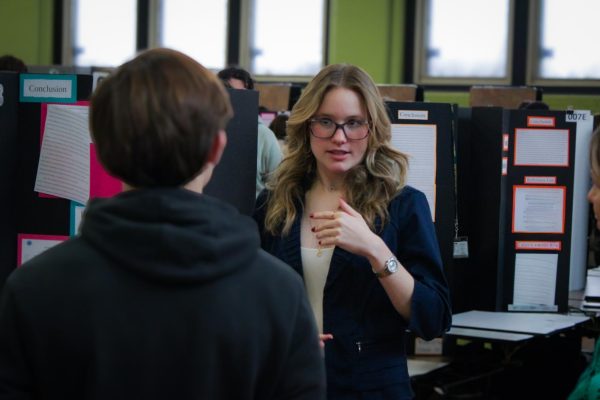
Sophomore Munia Abdelradi, who researched body language and emotional identification in neurodivergent individuals, approached science from a behavioral angle. She studied how different types of body language impacted neurodivergent people.
“I looked into what neurodivergency was, what types of body language there were, and specifically how neurodivergent people took body language and how they read emotions,” she said. The science fair helped her find out what she wants to major in and what college research would look like.
Freshman Edison Gong examined the relationship between population density and freshwater acidification. His research explored how acidification affects animals and how it occurs. He said he might return to the science fair if he had the right project and more time to complete them.
Senior Riley Coomer conducted ecological research on seasonal urban wetlands. She wanted to know if algae species in seasonal wetlands were unique or if they were simply reintroduced from river floods.
After collecting samples across multiple different watersheds and examining them under a microscope, she found that seasonal wetlands host unique species compositions. Her findings show that wetlands operate independently from nearby rivers and emphasizes the need for ecosystem protection.
“This is important because for conservation efforts, it’s important to understand that there’s differences in ways to protect these ecosystems,” Coomer said.
Another senior, Yairely Marchan, investigated whether the compound emodin, which is released by the invasive buckthorn plant, could be absorbed by allomelanin, a form of plant melanin. Since many invasive species release harmful chemicals through allelopathy, understanding how to neutralize those substances could help restore ecosystems.
Marchan collaborated with Northwestern University to conduct this advanced lab and research work. “Over the summer, I did an internship with them. So it was just easy to get that connection,” Marchan said. She also mentioned that she continued participating in the fair as she could use lab equipment and find meaningful research opportunities.
Marchan won first place in this year’s science fair, followed by Coomer and Evelyn Mooney, who designed a protective biodegradable packaging. They, along with the other top 15 contestants, will advance to the Regional Exhibition at Von Steuben High School on January 10th.
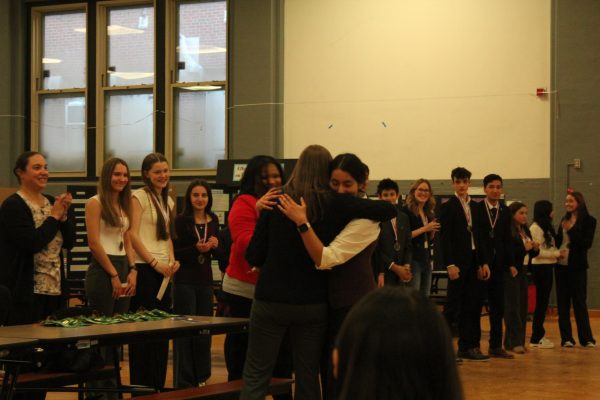
This science fair could not run without volunteers, teachers, and mentors. Alpha STEM Program deputy chair Michelle Loh, and several seniors including Anna Tataryn, Olivia Jones, Diego Landeros, Emily Ba, and Zoeh Olmedo-Muniz, were some who helped to guide the younger students and keep the event organized and running smoothly. Furthermore, Mrs. Lucy Young, the current Alpha STEM program chair, has contributed to the science fair for over a decade.
Seniors described the many responsibilities they had, ranging from directing late arrivals to assisting with setup. Yet, they can also serve as mentors. “It’s a really nice thing to kind of go full circle and help out,” Landeros said. “When you were a freshman and sophomore those same mentors helped you out.”
Students typically begin researching at the start of the year, though some juniors and seniors continue multi-year projects. Freshmen spend nearly the entire school year learning how to conduct research, while older students often begin over the summer to prepare for the December science fair. Projects are evaluated by teachers, student judges, and guest judges based on the quality of their presentations, scientific writing, creativity, clarity, and research depth.
Beyond awards, many students say that the fair shapes their academic futures. Senior Emily Ba said participating helped her discover her future career.
“I did three years in a row of aerospace projects and discovered multiple fields within aerospace that I’m interested in,” Ba said. “That was really important for me because I’d never really seen a place to explore aerospace before [the science fair]. And that really gave me that opportunity to delve into that interest, which now I have love enough to major in it in any college I go to.”
The seniors also credited the Alpha program with connecting them to internship opportunities from cancer research at UIC to pediatric brain organoid studies at Northwestern. “Alpha just gives you those opportunities,” Landeros said. “It’s just a great aspect, [and] a great program for the community too.”
As the fair wrapped up, it became clear that its purpose extends beyond the projects displaced on the tri-fold boards. For many students, the science fair is where passions and futures begin to take shape.