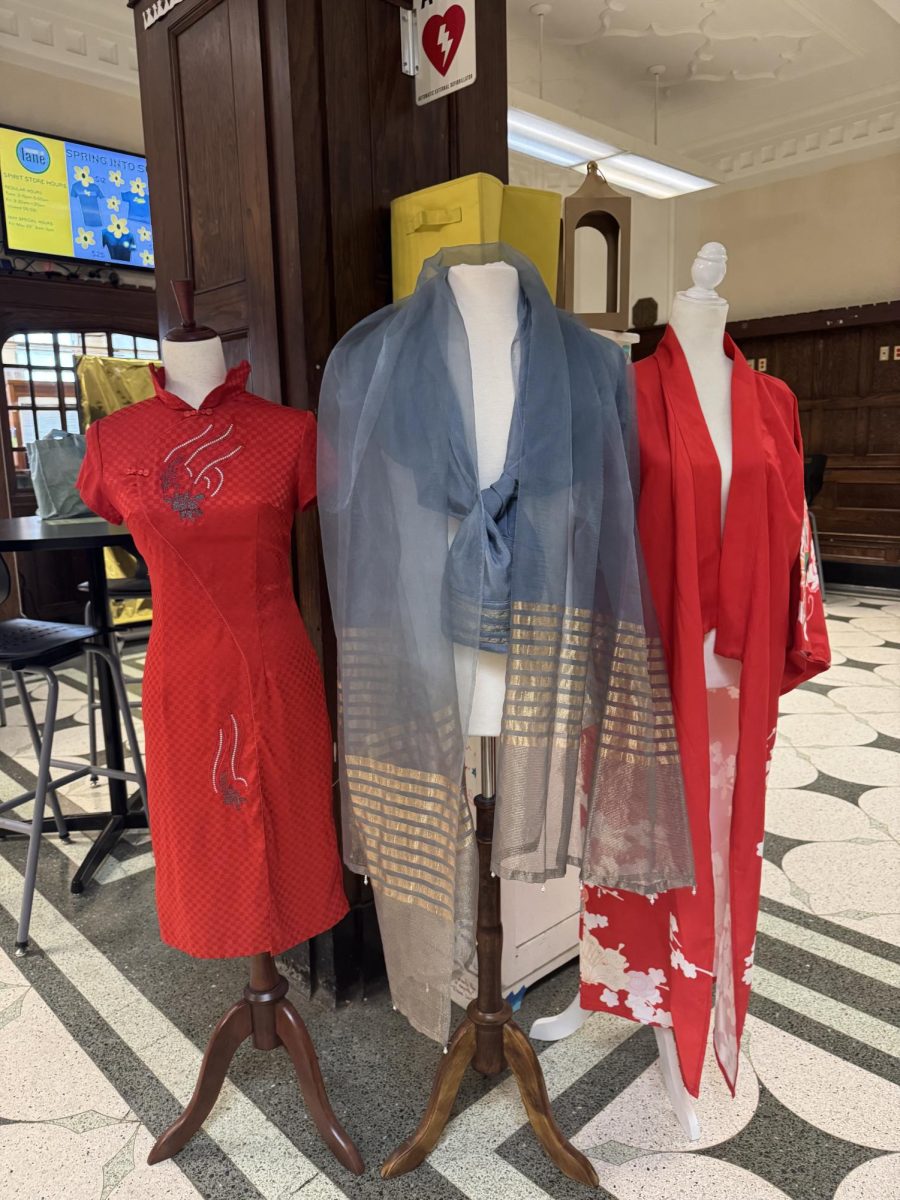
Every year, Lane recognizes Asian Pacific Islander Heritage Month. There is an annual Lane Tech Asian American Cultural (LTAAC) showcase held in the auditorium.
This year, the date for the LTAAC Showcase is May 19. Dances, songs, and other types of performances are expected to be presented to the audience members during the showcase.
There are currently two Asian languages taught at Lane: Japanese and Chinese. Sundy SaTsu is currently the only teacher that teaches Japanese. Dana Anderson and Pei Yeu Chang are currently the two teachers that teach Chinese.
Anderson teaches her Mandarin class the language and the culture of China. “[The aspects of Chinese culture] are based on what we are currently learning [with the Chinese language],” Anderson said.
Like Anderson, SaTsu teaches his Japanese class about Japanese culture. “[I teach my students Japanese events such as] children’s events, other things, like New Year’s,” he said.
After school, Asian-Pacific dedicated clubs host their meetings. For the 2025-26 school year, there are eight I-Days Clubs focusing on specific Asian-Pacific cultures. Some non I-Days Clubs that focus on Asian culture or identity include National Chinese Honor Society, Asian Pop Dance Club, and Filipino Student Association.
Lane Tech Asian American Club is one of the Asian-Pacific clubs that does not focus on I-Days dances. Senior Trang Nguyen led meetings in the danceroom and lunchroom after school every day, in which Chantelle Fergoso and Emilyne Villasenor sponsor the meetings.
Nguyen said “I’m pretty proud’” to become a part of LTAAC, since she was a sophomore. Ever since she has joined this club, she said her experiences “taught [her] a lot about leadership and how to work together with students and others” and also said she got to build this club for not only herself, but the members in her club.
“I just feel that bringing the Asian community together to represent all the different cultures around Asia is very meaningful to me,” Nguyen said.
Like LTAAC, Filipino Student Association (FSA) is another club that focuses on Asian culture and identity but not dancing. Seniors Kaela Allawan and Jason Lukian led meetings in the dance room and Room 144 after school on Wednesdays, in which Anthony Gonzalez, Chantelle Fergoso, Emilyne Villasenor, Kelly Novak, Maria Olea, and Tiffany Williams sponsored the meetings.
One of the FSA Club Presidents, Lukian, said that the purpose of FSA is to highlight the culture of the Philippines and to bring awareness to this culture, such as what the culture is, the food, dancing, and everything else that comes from the Philippines.
Lukian said he ensured that every part of the Philippines gets the spotlight in the FSA because he said that “the Philippines is very diverse, even [though] it’s a small country”.
“I feel very proud [to be the Club President of the FSA] because, coming from a family that was made up of Filipino immigrants, it feels great that I’m able to represent my culture,” Lukian said.
Despite both Allawan and Lukian being very busy throughout the year, Lukian said he and Allawan tried their best ability to showcase Filipino culture to their members and plan events with other clubs at Lane to highlight their culture and other Asian cultures, while highlighting every part of the Philippines.
Another Asian Pacific I-Days club is the Pakistani Club. Seniors Alizay Kashif and Lena Wiercigroch led meetings in Rooms 254 and 259 after school on Tuesdays, in which Sahar Shafqat and Marrin Gillespie sponsor the meetings. Pakistani Club describes itself as: “a community for Pakistanis and those interested in Pakistani culture. It is a space for learning about cultures that are not your own and also for feeling a sense of representation and belonging in our school’s community.”
For this school year, the Pakistani Club danced in Punjabi Bhangra style, which Kashif described as “way more upbeat” and the female members performed a traditional Luddi dance, which is traditionally done at weddings in Pakistan.
Kashif said being part of the Pakistani Club made her feel “a sense of community”, in which the Club together embraced the Pakistani culture, ate the traditional food, and learned the traditional dances.
“I do think I feel extra prideful for being on Pakistani [Club] just because I am Pakistani myself, and because of the commitment that I’ve made, doing it for four years, but especially because I feel like there’s something really special about our dance, our performance, when it comes to our costumes and our music, and the level of energy, I feel like even more so than putting together dances,” Kashif said. “It’s about putting on a show where we’re having fun, and we have energy and providing a space where people feel happy in the community.”
Korean Club is another I-Days club that represents an Asian country. Seniors Andrew Choi and Lana Surgit led meetings in Room 219 after school on Mondays, in which Josh Park sponsored the meetings.
For this school year, the Korean Club performed Buchaechum, which is a type of fan dancing, which has been performed throughout centuries in both North Korea and South Korea. Surgit said the fans have “a significant look, ‘cause it has these flowers” and mentioned that the flowers are “very significant to the Korean fan dance and the culture”.
Not only did the Korean Club perform Buchaechum, but they also performed
Taekwondo, which has “KPop” influences.
Surgit said her club have “all put in a lot of time and effort” and “have developed meaningful relationships with each other,”when they practiced for I-Days over the months leading up to the event.
Asian Pacific Islander Heritage Month is celebrated all throughout May. This initiative officially debuted as a full month in 1992, after President George H.W. Bush signed a bill to recognize May as the Asian Pacific Islander Month. The bill originated in 1977 as a proposal by Representatives Frank Horton and Norman Mineta to honor Asian/Pacific American history.
Many Asian Americans around Lane found the Asian Pacific Islander Heritage Month to be when they would deem as important and would also celebrate. Many of these people have their own interpretations as to the meaning and purpose of the Asian Pacific Islander Heritage Month.
“I think [Asian Pacific Islander Heritage Month at Lane] is to honor all the Asian American students, and other Asian Americans that came before us, and to also celebrate the culture within Lane,” she said.
Lukian said, “I think [Asian Pacific Islander Heritage Month] means for me to be able to spread my culture, especially as an Asian American, obviously but being able to kind of be proud of who I am without being overshadowed or feeling like that I’m kind of like forcing my culture upon other people. It’s more like me being able to kind of embrace who I am, and show what Asian American culture is, and why it’s so important for it to be remembered and how it makes a big difference not only in Chicago, but in the U.S. as a whole.”
Kashif said she discussed Asian Pacific Islander Heritage Month with the Pakistani Club in group chats and showed appreciation for one another.
“[Asian Pacific Islander Heritage Month] is important to me because I feel like there’s not many times in the media where we’re represented where we get the opportunity to share our culture, and I feel like there’s a lot of stigma around, racist jokes, the media, and stuff like that, so I think it’s really important that we take it seriously and appreciate,” she said.
“I would say, the celebration of the Asian Pacific Islander [Heritage Month is when] everybody has the heritage from the area, including [myself],” Anderson said.
Non-Asian Americans also recognize and celebrate Asian Pacific Islander Heritage Month.
Surgit said the Korean Club performed in the LTAAC showcase by performing the dances they have danced at I-Days.
“I think it’s an amazing time to celebrate all the different kinds of cultures that are encompassed in AAPI communities, especially because Asia is the biggest continent, with a lot of people that love to celebrate different cultures,” she said.
Not only is Asian Pacific Islander Heritage Month the only way for people to have exposure to Asian culture and people at Lane, but they can be exposed to certain Asian cultures by taking part in either Japanese or Chinese classes, and/or watch the performances that represent a specific culture in the Asia-Pacific region.