As if carrying a five-pound, five inch thick binder across the school and up two flights of stairs every day isn´t enough work, members of Lane Tech’s Academic Decathlon team must also spend a year memorizing the entirety of its contents.
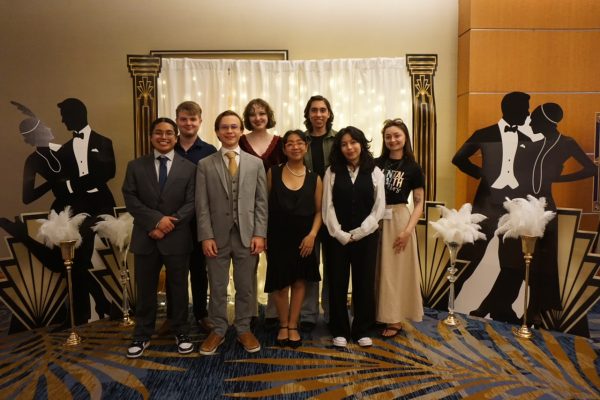
This dedication paid off, however, when Lane’s team placed number ten competing in the highest division, Division I, of Nationals in Garden Grove California April 23-25.
Team captain and Senior Honors competitor Mike Majweski, who medaled bronze in science at nationals, said, “This year was our first year qualifying for Division I, which means that, in fact, this is the best our team has ever done.”
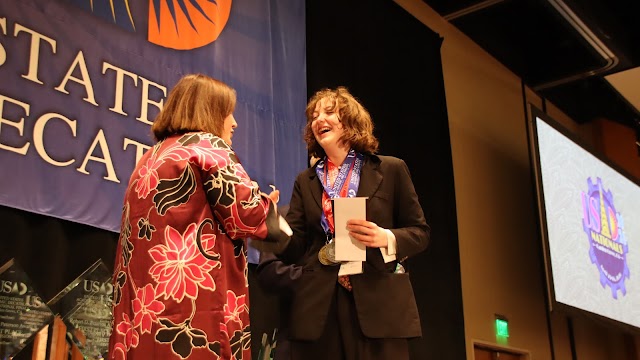
To the team’s additional resounding excitement, Junior and Honors competitor Drew Hogan individually placed first in the nation, medaling Gold Overall and in Art and Silver in Social Science, Music, Science, and Literature.
Explaining the enormity of this accomplishment, ACADEC coach Benjamin Fuhr said, ¨Academic Decathlon is divided up into divisions both for schools, by size and their overall scores, as well as within students divided into divisions based on essentially their GPA.¨ These divisions include Honors as the most competitive, followed by Scholastic and Varsity.
¨In the toughest division for schools,¨ Fuhr said, ¨so, the most competitive, largest schools, and in the toughest division for students, meaning the kids that get all straight As, our student, Drew Hogan, going to be our captain next year, scored the best in the entire country.¨
Reflecting on the steps leading to that point, Hogan said, ¨I always have to remember that everything I do is because so many people have put so much faith into me and have helped me so much and trusted me when I was growing into this. Any achievement you make on your own is a combination of what other people have invested in you and helped you with.¨
Senior and Scholastic competitor Giselle Alonso said, ¨I think that ACADEC is important, but the studying part of it is just sometimes a bit too overwhelming so I don’t always try my best. But when I see Drew taking the time and spending so much of their time and energy into memorizing so that they can perform well, not just for themselves but for the team, it’s really inspiring.¨
Lane competitors have reflected that being a part of the teamś supportive community is one of the most rewarding aspects of the program.
¨There’s something special at ACADEC. There’s so many close relationships and it´s great to get to go back to that every year and help a new one blossom with a new group of people,” Hogan said.
Having achieved an incredible goal, Hogan said that they are looking forward to stepping down from competing next year so that they may take on a new role.
¨I really want to focus next year on helping boost other people and make this team into something that can thrive and survive for the next, hopefully, few years or decades,” Hogan said. ¨We don’t really have a proper teacher in our class who makes lesson plans and curriculums and such, so I want to take more of that role and really help people get into a space where they can be as comfortable as possible and ready to give it their all.¨
Majewski said that the teamś successes this year were a ¨reflection of the combined dedication to learning the material, but also refining your character.¨
Competitions are split into seven multiple choice tests on the subjects of art, literature, science, social science, math, music, and economics, all oriented around a central theme – this year, the roaring twenties. Aside from memorizing information from resources on each of these subjects, where competitors stand out is in their performances in each of three ´subjective´ categories, speech, interview, and essay.
In these categories, Majewski said, ¨you can generally score well by having a good character, by showing improvements in your character and demonstrating this in how you speak, how you present yourself, the way you conduct yourself. It’s these things and skills you learn about how to professionally engage yourself that make you successful in acadec.¨
In this way, Fuhr said ¨this class, I think, is great if you have good executive functioning, and it’s also great if you want to build good executive functioning.¨
Case in point, Fuhr said, ¨I was talking to the state director, and they’re actually raising the GPAs for the lowest division because what keeps happening is that kids that typically don’t have the best grades come into Academic Decathlon, and then their grades go up because they learn executive functioning skills. I think as a takeaway there, it really does make the kids grow, even though it certainly has its faults and foibles as a program.¨
Varsity competitor and Senior Jace Ansah said ¨It was very stressful at the beginning of the year, but I think once you get the hang of it and you go on a bunch of scrimmages, I think competing is really fun because you get to see your scores and you get to see all of the work that you´ve done sort of pay off.¨
Castillo said ¨a of the techniques for studying, the public speaking skills, and social skills have all come from ACADEC, and these skills have helped me in so many aspects of my life that it has just become an essential pillar of learning for me.¨
¨My study techniques have really improved over time as I´ve found out what´s worked for me and what´s not,¨ Hogan said. ¨But more so, I´ve just learned how to coexist in a group of other people and help each other out, and grow together. You have to really work to get those team dynamics all right, and kind of growing up in that space really helps me to become a better person and friend.¨
Reflecting on the impact the ACADEC program has had on their life, Hogan said, ¨I feel like I’ve grown up on this team a lot as a person, as a competitor, as a student. I´m very different from the person I was when I joined at 13. It´s kind of crazy to look back.¨