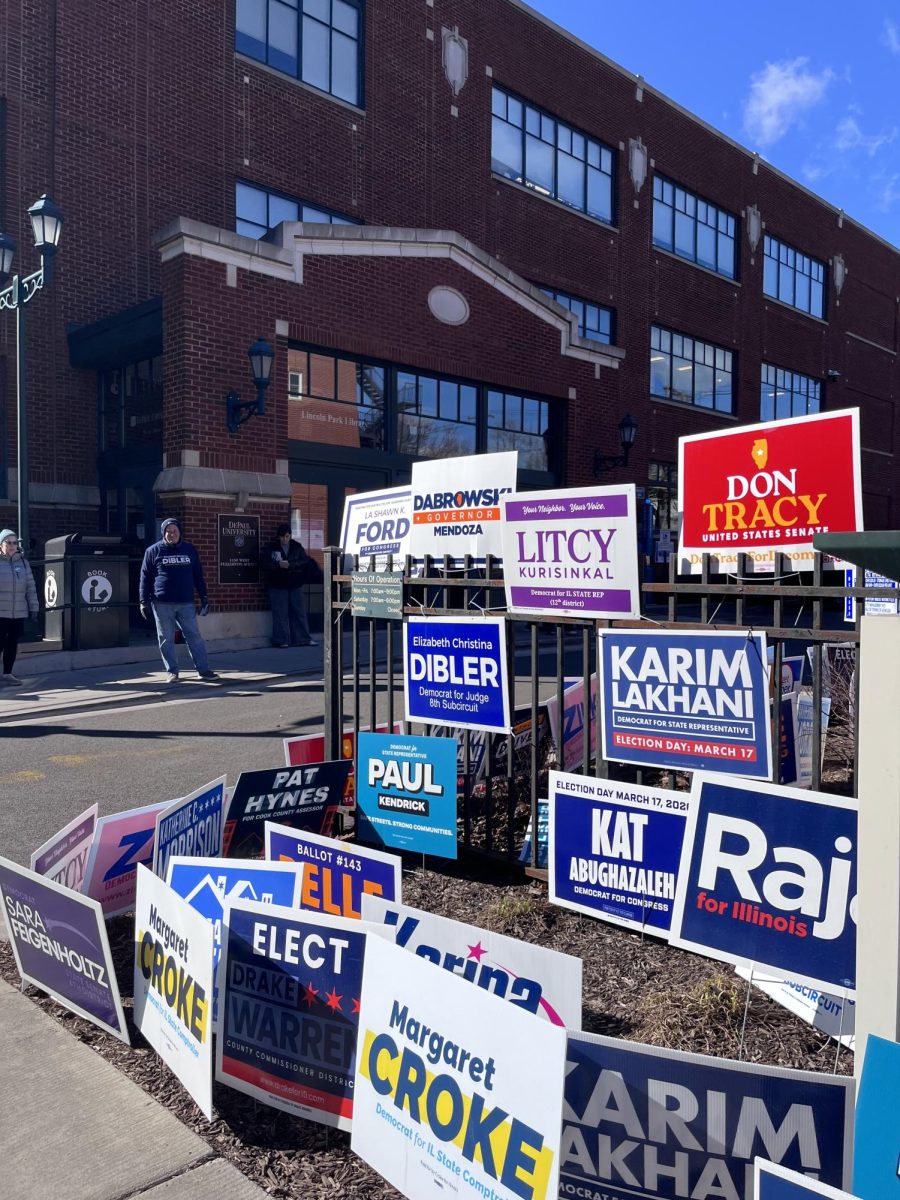
Voting Day for the Illinois General Primary Election, March 17, marked the first time many members of the class of 2026 could cast their ballots.
For Senior Karina Bergman, this was an experience which came with much excitement as well as responsibility. From doing proper research in advance to speaking with family and new-voter friends about candidates and the voting process, Bergman said, “It’s important because we’re going to run the world one day.”
Senior Arhum Butt said that he hoped young people would vote more because of their ability to influence election outcomes. “If all the people of that age demographic voted, we could swing it really easily,” Butt said.
Appreciating that potential impact, senior Kaline Adams said, “I definitely have a lot of contempt for the system of government that we have, but as long as we’re in this system of government, I’d like to have as much control as I can, and I’d like to have at least some say.”
“I can’t complain about it if I’m not going to do anything about it,” Adams said, “so something as simple as voting is just the least I can do.”
Adams took her involvement a step further than voting by becoming an election judge. “It was good to really know what the system was, and made it quicker and easier when I actually went to vote,” Adams said.
Conducting research before voting to streamline and inform his decisions, Butt said that he worked with his sister to find an online resource “that agrees with our views a lot. And we used that resource to see what candidates were endorsed.”
AP Government and Politics teacher Melissa Smith said that careful research has become especially important due to the proliferation of AI media. Smith recommended referencing official Board of Elections websites. “My advice would be to try to get your news from multiple sources so that you can have multiple perspectives on things and fact check,” Smith said. “Be a smart consumer of content.”
Electioneer Margot Lovill served as one source of information about candidates for passersby at an early voting site for the General Primary, and said that she is careful in the research process on candidates herself.
“I find special interest groups that I care about and see how they’re voting,” Lovill said. “Let’s say if the candidate has a record if they’ve been in office before,” Lovill added, “I look at what bills that they voted on that may be aligned with unions or environmental groups that I care about and see if they have a good track record of supporting those things.”
Lovill also recommended viewing candidates’ social media accounts to take note of what issues they pay attention to and who else they follow. “Who they surround themselves with will be a good reflection of how they also operate,” Lovill said.
Electioneer Pat Graham said that when speaking with prospective voters, “you try to align who they are and what they care about with what your candidate can do for them. Importantly, we want to listen to them because very often people aren’t heard and they need to be heard.”
In order for young people to raise their voices, Graham recommended that people involve themselves in addressing local issues. “Take an issue that you’re mostly interested in,” Graham said, “and find an organization that’s working on that on a ground level so that you can not only influence what they’re doing as a younger person, but learn how to organize. The organizational piece of it is crucial if you want to really get something done.”
This is not only a way for newly involved voters to learn about issues they care about, Lovill said, but to find evidence of candidates who will work to address them. “I think going out and protesting and seeing what politicians and representatives show up and stand with the community is really important,” Lovill said.
Providing opportunities to become politically involved, Smith encourages her students to contact their local representatives and lawmakers about pending bills through a civic service learning project. Smith even brings a group of students to D.C. each year through a program called Close Up to allow them to “see democracy in action.”
“I try to show them through example that they can make a difference. I’m hopeful with your generation that your generation seems to be a little bit more politically active and willing to take a stand with walkouts and everything,” Smith said. “That excites me for the future that the status quo won’t necessarily be accepted, and that we will look to change things for the better.”
Smith said that this political participation of individuals is one of the driving forces of democracy. “Even just being cognizant of your plate and of other people’s plates and trying to make the world a better place is a good mindset for anyone to have, but definitely with the kids,” Smith said. “It’s hard when you’re an 18 or 17 year old in the big world, and you don’t really see that you can make a difference. But if everybody thought that, then nothing would ever get done.”
Data from the Illinois State Board of Elections indicates that youth votership is rising in Illinois, as the number of voters between the ages of 17 and 34 increased from around 62,000 in the 2022 primary to over 85,000 in this past primary.
“I can see where it would be daunting to think you don’t have a difference to make, but the young generation is typically the most underrepresented group of people in voting,” Smith said. While this may be due to complications such as being away from home at college, Smith said that she thinks young people should and are getting into “the mindset that, hey, this world is my responsibility. It’s everybody’s responsibility. We have to work together — it’s a collective thing.”
“The earlier they can start to see that,” Smith said, “the earlier they’ll be willing to step out and step up in terms of making their voice heard on what they want and what they think is best.”