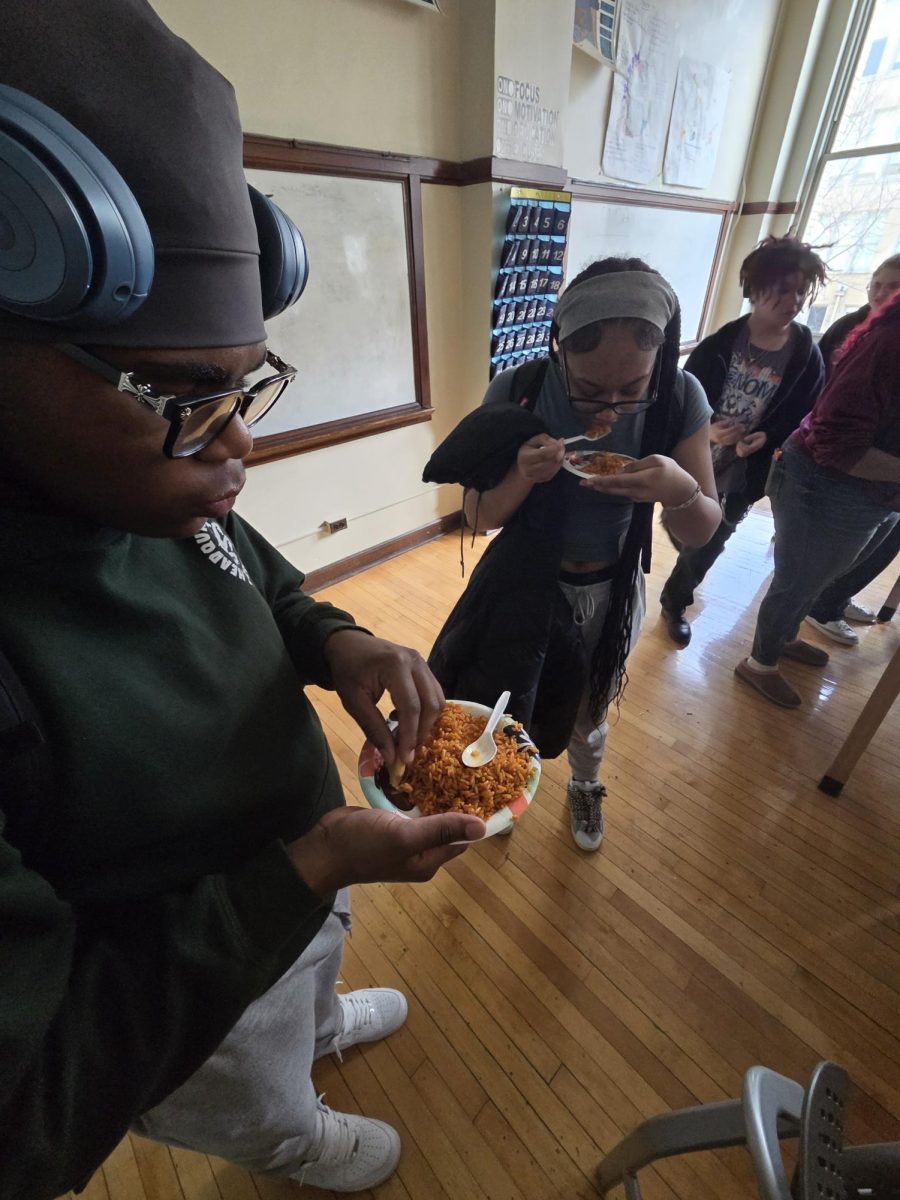
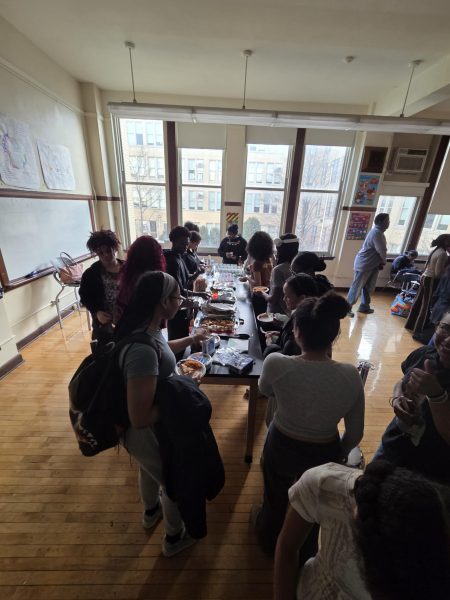
Students tried foods served by the Middle Eastern North African (MENA) Club, West African Club, and East African Club and had laughter and chatter after school Feb. 12 in Room 210. Lane’s Black Student Association (BSA) organizes and hosts the annual event.
Room 210 was loaded with people. All the seats were filled with students; which even subjected others to having to resort to sitting on the floor. But despite the lack of space, everyone seemed to be having a good time, enjoying their food.
Although Taste of Africa has previously been held in the lunchroom, this year’s event as well as last year’s event took place in Room 210. According to Senior Sanyah Bovan, the BSA President, the change was due to scheduling and space conflicts.
“It used to be in the lunchroom,” Bovan said. “But during this time, I-Days Clubs also start to practice in the lunchroom because it has more space. So due to spacing, we decided we could just use 210.”
According to Tiffany Williams, the sponsor of the BSA, the purpose of the Taste of Africa event was to incorporate Black and African cultures in terms of food as a way for “the kids to experience the type of foods and what they need to the culture.”
Adding to Williams’ statement regarding the purpose of the Taste of Africa event, senior Karter James, the Vice President of the BSA said, “I feel like it’s very important for other cultures to be included and for Africa as a whole to be noticed, and even through food, our culture is very unique, and I feel like people need to know about it in order to have a more broader perspective of just the world in total.”
The Taste of Africa event started with a slideshow, in which each slide focused on a particular club, the food they brought to the event, and a description of each food. In the order of the slides, East African Club’s sambusa, West African Club’s jollof, and MENA’s baklava.
Food for the event was largely contributed by Club members. According to Bovan, in previous years, much of the executive board personally prepared the dishes. However, after many of those members graduated, BSA expanded the event to include more clubs, specifically clubs that focus on specific African cultures.
“This is actually the first year we’ve included East African Club as well as the Middle Eastern and North African Club,” Bovan said. “Since they graduated last year, we decided to make it a multi-club event.”
MENA brought baklava to the Taste of Africa event. According to the club presidents of MENA, baklava is a common pastry mainly has ties to Tunisia, Algeria, Libya, and Egypt in North Africa and Turkey in the Middle East. This Middle Eastern and North African dessert is popular in North Africa after “the Ottoman Empire influenced their desserts”.
The West African Club brought jollof rice to the Taste of Africa event. According to the West African Club, this rice dish is popular in West Africa and originated in Senegal, representing “the cultural unity of West Africa.” Jollof rice is described as “a staple at parties, celebrations, and family gatherings in Nigeria.”
The East African Club brought sambusa to the Taste of Africa event. According to the East African Club, this pastry is connected across East Africa and the Middle East. Sambusa is often served during traditional holidays, and “a reflection of the countries’ rich food traditions.”
In order for MENA, East African Club, and West African Club to show up to the Taste of Africa event, James said BSA contacted them to bring food together on the same day and at the same time. “It brought us together to create Taste of Africa, because we just, we kind of just combined these two, all these clubs, and we got together, and we’re like, ‘oh, we’re gonna bring this, or we’re gonna bring that,’ and that’s kind of how it really got started.”
The Club Presidents representing their participating club either brought dishes from different African restaurants or they made their foods at home. “We set [the foods] up just like the regular Chicago tastes, where we had little plates and everybody got a sample of each piece after we did the presentation of the foods,” Williams said.
Despite the Taste of Africa event being overcrowded in a smaller setting, students were able to taste and eat foods from North Africa, West Africa, and East Africa, making themselves aware that these foods exist. They were also able to have an enjoyable time in the event, laughing and chatting all throughout the time.