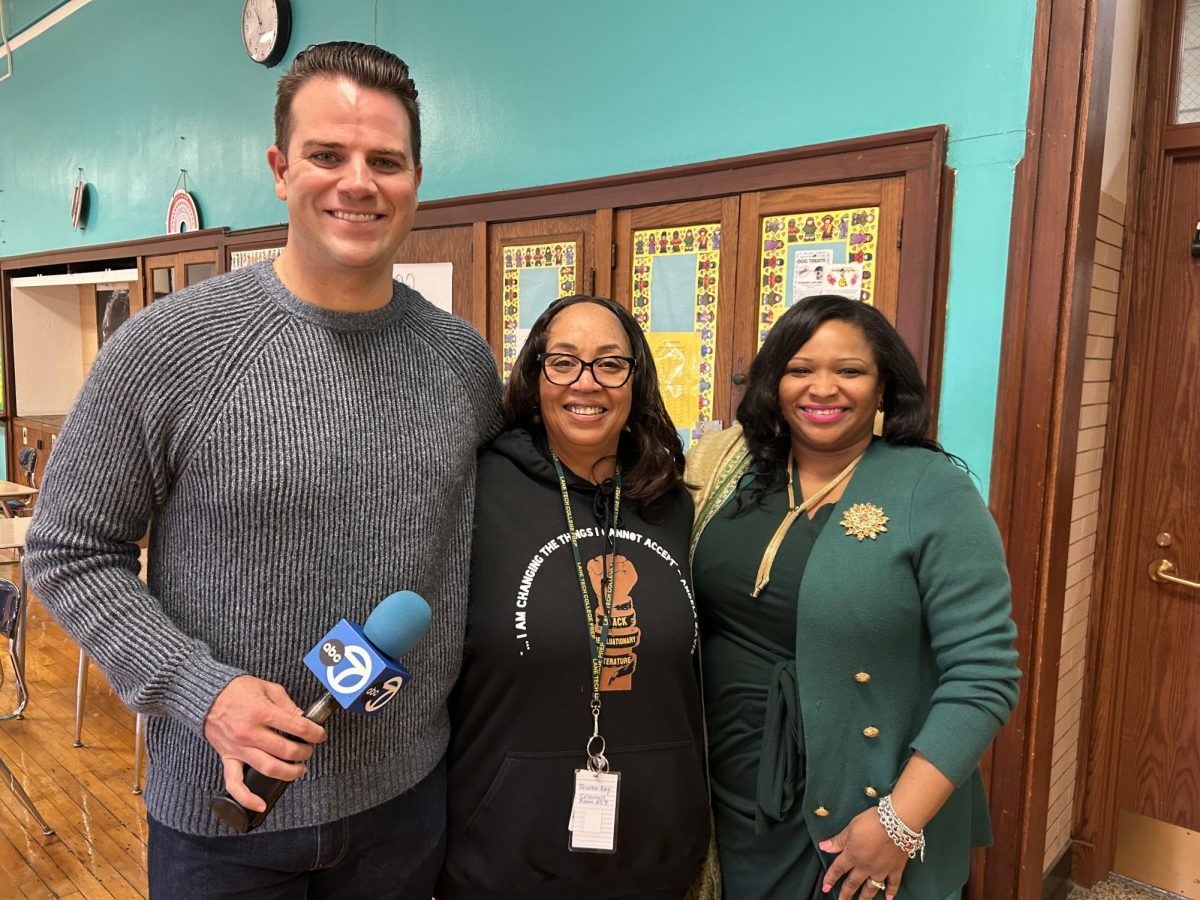
When a revolutionary looks at systemic racism, according to Ms. Coleman, they see it for what it is. Cancer.
“You cannot put a bandaid on this. You have to pull out some of these systems by the root and replace them with institutions that work. That’s a revolutionary,” Ms. Coleman added.
Black Revolutionary Literature did not begin with that name — it started out as African American Literature, a course that became available to Lane students in 2008. The goal of this course could be viewed in its name, simply to introduce under-appreciated African American literature to students.
Under its original name, African American Lit. was designed and taught by Lane’s current principal, Principal Thompson. Principal Thompson taught African American Lit. for two years, until she entered an administrative role at Lane in 2010 as Assistant Principal.
Ms. Coleman then took on the task and evolved the course into Black Revolutionary Literature, an inviting, yet, more radical education utilizing the writings of Black activists throughout history. The class is offered to seniors as a core English class or an elective. Her decision to change the course was sparked by the death of 17-year-old Trayvon Martin in 2013, African American Lit evolved into Black Revolutionary Literature.
“The reading that we do is designed to teach students how to revolutionize,” Ms. Coleman said in regards to the intention of her meticulously planned curriculum.
“My students are taught to revolutionize health care, revolutionize education, and whatever field they go into,” Ms. Coleman said. “That requires a different kind of writing, a writing that is more unapologetic, less user-friendly, and more demanding.”
Nikia, a senior taking Black Rev. Lit., said she has begun to recognize the importance of being involved in the problems she sees around her. “I think it also inspires you to be a revolutionary, meaning to change the world around you. Create the change you want to see, instead of just looking at it as such,” Nikia said.
Ms. Coleman’s teachings stick with students beyond the classroom too. She recalls a time she was able to witness one of her former students go from learning what it means to be a revolutionary, to practicing the act of revolutionizing.
“I have a student who went to a college on the East Coast, and it was a nightmare for her because she was the only Black fill in the blank. She came home after her first semester and she came to visit me; she said: ‘I can’t go back there. I was faced with so many people wanting to touch my hair.’“
However, these are just the situations that Ms. Coleman intends to teach her students to work through. “It takes courage to be a revolutionary,” Ms. Coleman said. “First of all, let’s start with the definition of the word radical, which is a word that [activist] Angela Davis often talks about. Radical means to pull something out by the root. A revolutionary is a radical.”
The courage that it takes to become a revolutionary is what Ms. Coleman intends to instill within her students.
“I can’t go back there,” the student continued, “but if you tell me to go back, I will.”
Ms. Coleman recognized the significance of her student putting that responsibility in her hand. “Do you know what I told that baby?” Ms. Coleman said. “I said, you gotta go back. You have to go back. You need to be in that space. You deserve to be in that space.”
Taking Ms. Coleman’s advice, her former student returned to the college. “But she went back like a revolutionary goes back. Do you know that this student started the first Black Student Association at that college? There wasn’t one. She created and opened the doors for so many, many students who were black and were there at that time, and students who would go there,” Ms. Coleman said.
“Thats just one example, of the many examples, of my revolutionary students getting out there changing the world,” she added.
India Davenport, a captain of Lane’s majorette team and student of Ms. Coleman, spoke about how Black Revolutionary Lit. affected her post secondary education plans: “The Black community is held back by the criminal justice system,” Davenport said. Black Rev Lit. has inspired her to pursue a degree and eventually a career in criminal justice with hopes of revolutionizing the system, she said.
A tool Ms. Coleman emphasizes to her students is the ability to read and write at an intellectual and professional level. “Ms. Coleman definitely taught me to write better,” India Davenport said. “She really is dedicated to teaching kids how to write better.”
Her daily quotes, such as Mos Def’s “Speech is my hammer. I bang my world into shape,” allow Ms. Coleman to draw the interdependent relationship between being a revolutionary and being an intellectual.
“Lane Tech students are problem solvers,” Ms. Coleman said. “And so, what I find myself doing is presenting them with a problem, a model; and I’m providing space and tools for them to find the answers.”